Questions and Answers
In my time on the New Boston School Board, I've received quite a few questions from various folks I've spoken to. In some cases, there are things that are going on in the news right now that are important for voters to think about. In other cases, it's more of a state-wide policy issue, but that has an impact on local schools like NBCS. This page is a running list of all of those questions/topics over the years, and my answers and thoughts on them. If you would like me to address something that isn't listed here or elsewhere on my site, please contact me.
• "What have you done to prepare for a position on the New Boston School Board?"
Prior to my initial election to the School Board in 2023, I read through a wide selection of theNBCS and District policies, the Student Handbook, and the Teachers' contract (and helpful related slideshow), among other resources, to become familiar with existing policies and procedures. I've also attended almost every school board meeting, in person, since the start of the 22-23 school year. I've listened to the School Board conduct their meetings, talked with members of the administration, and also had informal conversations with parents (including members of the PTA), with teachers, and with current School Board members. As a result, if elected, I will feel very prepared to start contributing to the School Board's duties from the get-go.
See a more detailed response
There really isn't much more to say. I understand education and education policy because I'm an educator myself. I understand teachers' unions and contract issues because I am an elected member of my own union's executive board, and deal with grievance issues between faculty and the administration. I understand the statistics and data because I'm a researcher trained in understanding and using data, especially social science data, to answer questions and evaluate policies. I also understand the issues that parents of elementary school children face because my own two daughters attend NBCS. So, in general, I feel very prepared for a position on the School Board.• "Wait, do you live in New Boston? There's a Kelly M. Socia who lives in Goffstown, and he posted on Facebook about [a Party Bus business; his elm tree being eaten by a porcupine; some random meme that may or may not be insulting]? Did you run for a Vermont senate seat a decade ago?"
I can see how this might be confusing. I am actually Kelly M. Socia, Jr. -- my dad has the same name, and he (and my mother Kim) live in Goffstown. He's a retired postal worker, has run a Party Bus business, ran for a Vermont senate seat years ago, and sometimes posts things to New Boston pages. The main difference is that he's in his 70s, and I'm in my 40s (and yes, I live in New Boston).
See a more detailed response
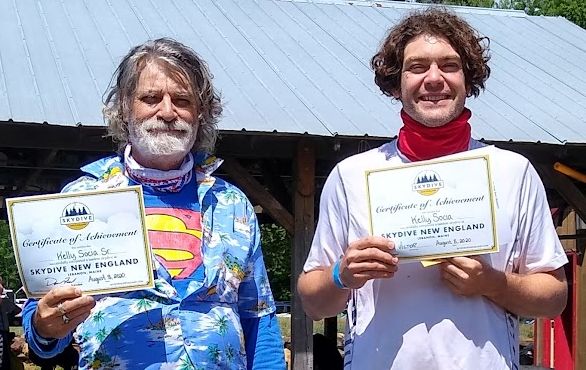
This is my dad (left) and I (right) shortly after skydiving a few years ago.
• "What is your view on the statewide 'school voucher' program?"
While I'm in favor of parents having the ability to send their children to whatever school (or homeschool) they prefer, I am strongly opposed to the school voucher program in NH. What we've seen over the last few years is an explosion of funding being leeched from the Education Trust Fund and used for private school options, to the tune of tens of millions of dollars each year. Now, there are no income limits and an continually increased cap on the number of enrollees, so this amount will only increase.
See a more detailed response
For those of you not familiar with the school voucher program in NH, these are also known as Education Freedom Accounts, Education Saving Vouchers, and/or Education Savings Accounts. These resulted from a proposal that was slipped into the 2021 state budget at the last minute, even against strong public opposition. The program has not only been subject to lawsuit(s), but has already cost taxpayers tens of millions more than state education officials initially projected. Proponents say that this program allows parents the opportunity to send their children to the best educational option available to them. However, statistics show that the vast majority of families taking part in the program already had their children enrolled in private, religious, and/or homeschool options. Thus, rather than increasing educational choices for parents, this program has mainly been a way to funnel state funding meant for public education to private options. To be clear, these vouchers are not accounts that allow families to pay for private tuition costs with their own pre-tax dollars (like 529 accounts do), but rather they scoop out public funding to benefit individual students, thus harming local public schools that serve the majority of the children in our communities. (On a side note, it's surely no coincidence that one of the main proponents of school vouchers, former State Education Commissioner Frank Edelblut, chose to homeschool his own children.) Additionally, over the last few years the eligibility for the voucher program has gone off the rails, such that there's now no income limits to qualify. You could literally make ten million dollars per year and your family would qualify for EFA money. State-level funding for NH public schools is already notoriously inadequate, and EFA programs only aggravate this problem. For all of these reasons, I am strongly opposed to school vouchers/EFAs in their present form, at least until the state is funding a true adequate public education for every student.• "What do you think about the funding levels of NBCS, and school funding in general across the state?"
I think that the state has been historically underfunding local schools for decades, in direct violation of the law. This means that most of the funding of schools falls on local municipalities to figure things out on their own. For a town like New Boston, with relatively few businesses to help support the budget, this means that the funding is raised primarily by property taxes on homeowners (which is also passed along to renters in the form of higher rents). Thankfully, despite having great student achievement levels, NBCS has one of the lowest per-pupil costs in the state (see my Data page for more details). So, while I would love to have better state funding of local schools, including NBCS, the reality is the burden falls on local property taxes to ensure our children are able to attend a well-funded public school.
See a more detailed response
An interesting, albeit concerning, fact is that NH has the lowest proportion of state funding, and highest proportion of local property tax funding, in the country. While recent proposals in the state legislature may help with this, and the state certainly has the money to better fund local schools, I'm not holding my breath for the dismal state funding levels to change anytime soon. This problem is also compounded by the budget-busting 'school choice' voucher program, that is taking money from state coffers to fund private schools and Amazon.com purchases (yes, really). These are some of the reasons why I think the burden on local taxpayers to fund schools is not going to be alleviated anytime soon. This means that School Boards need to balance fiscal responsibility with educational needs, to ensure that the school has adequate and effective funding, without overburdening local taxpayers. A longer-term solution would be to actually fix the abysmal levels of state education funding. But that problem is well beyond the scope of the local School Board to solve, and instead falls on voters to elect government officials who support public education.• What do you think about Divisive/Subversive Concepts laws, the Right to Freedom from Discrimination in Public Workplaces and Education Law, "Don't Say Gay" bills, book banning bills, or similar legislation that limits what can be taught in schools?
“Those who cannot remember the past are condemned to repeat it.” –George Santayana.
This is an apt quote that covers a lot of my feelings about these types of laws. Although in this case, I would modify it to be: "Those who are prevented from learning about the past are condemned to repeat it." In short, I opposed these types of censorship laws in whatever form they may take. They are based on bad ideas and they lead to bad outcomes for children and society as a whole.
See a more detailed response
I think that parents should trust teachers to be the experts in what their children should be learning in the classroom and how it is presented. I also think parents should have more faith in what their children can "handle" in terms of educational content. If parents disagree with the current curriculum in some way, there is already a process in place to file their complaint with the School Board for consideration, and there is also always the option for the parent to choose to send their child to an alternative school that is more in line with their beliefs about appropriate content.However, the wholesale censoring of children from learning about certain concepts, certain viewpoints, certain 'takes' on history, or being exposed to certain kinds of speech in an educational setting (and yes, books count as 'speech'), is a very slippery slope. These laws (or other actions taken to shelter children from any and all 'divisive' concepts they might be exposed to), end up producing young adults with limited critical thinking skills and limited (or simply false) knowledge regarding history and society. It hinders development of a variety of skills needed to successfully integrate into a modern day society, one that's made up of people with differing viewpoints and characteristics that sometimes are in conflict. By allowing only certain 'kinds' of history to be taught to children, it leads to adults who not only have a historically inaccurate understanding of the past, but worse, also unable to critically think about their place in the world, or even begin to understand that they might be wrong about things. This may have been less of an issue hundreds of years ago, when the average person would only ever interact with the people living within a few miles of where they were born for their entire life. But these kinds of 'forced ignorance' policies simply don't work in the modern world, and those proposing such bills would do well to research some (real) history first.
Additionally, there's been some media outrage about the potential 'indoctrination' of children by teachers (including at the university level). Yet indoctrination requires the repetition of a single message, over and over. To protect against this requires the exact opposite of banning certain messages. That is, children (and adults) should be exposed to many different sources of information (with varying 'takes' on issues) in order to have a more complete picture of a given topic. This allows someone to think for themselves, rather than being fed a single message with no alternatives. This means that laws that would ban certain books, certain lessons, or even certain words, are not only not protecting against indoctrination, but rather are enforcing a policy of indoctrination to whatever message is 'allowed' to be taught to students. Our children don't deserve to be indoctrinated about any viewpoint, and instead should not only be exposed to many sources of information, but also be taught critical thinking skills so they can learn to think for themselves.
So to again summarize my opinion about these types of laws/bills/policies: They are not a good idea, and I do not support them.
• "What are your thoughts on the Parent's Rights Bill?
I have read the Parent’s Rights Bill as proposed by the NH Senate.
The specific proposal outlines 23 separate ‘rights’ that parents would have (items ‘a’ through ‘w’), were this to become law. In my opinion, most of these rights are either 1) common sense, 2) already otherwise protected at the Federal level, and/or 3) are not very controversial.
So, overall, I think that most of the proposed ‘rights’ are reasonable, and that I would be in favor of. That said, I do not agree with the entire list wholesale, and so I wouldn’t personally support the existing proposal without modifications (not that I have a direct say in whether this is passed or not). There are a couple of things on the list that I either partially disagree with or I think have wording that is either unclear or too broad as presently written, and four items on the list I do not agree with entirely. So while the majority of items I do support, I do not support the current version of the proposal.
See a more detailed response
Hello. You're looking for a detailed response, which really means you want to know which items I 'have a problem with'. I get that. I'm not going to change your mind with the below details, and you're not going to change my mind. So while I'm going to be very open and honest about my thoughts on these items, I just ask that we agree to disagree, if that is the case. No need to send me a nasty email or whatnot. If you really want to discuss disagreements on these items with me, I'm happy to do so over a coffee at the Northeast Cafe. With that disclaimer out of the way, here are the details:There are two specific items that I only partially agree with, and would want to see tweaked:
•Under item (b), I do not agree with the inclusion of the Education Freedom Account program in the list of things a parent should be able to choose, as I do not support the current version of the EFA program, as I’ve explained in an answer above.
•Under item (g), I do not agree with the wholesale exemption of any and all immunizations based solely on a parent’s religious belief, at least as it is currently worded. If a religious exemption is included as a way to exempt a child from an immunization, then it should be the burden of the parent to show reasonable proof of a valid religious belief that prohibits the immunization. So, I would prefer stronger language to ensure that any such exemptions are able to be proven, and are not just accepted because a parent says they feel that way.
Note that I am not saying that any and all immunizations should be required automatically. Some immunizations should rightly be a parent’s (or student’s) choice, and not the school’s. For instance, I think that for minor children, the Covid vaccine should be a parent’s choice, rather than being mandated. Ditto with the annual flu vaccine. But things like the measels vaccine should absolutely be required. Period.
•I personally do not agree with item (j), which would allow parents to opt their children out of “health or sex education and any other objectionable material, as set forth in TSA 186:11, IX-b and IX-c.” This covers all topics pertaining to “Child Abuse Prevention, Youth Suicide Prevention, Intoxicants, Drugs, HIV/AIDS, and Sexually Transmitted Diseases.” I think that opting students out of this type of information is short-sighted and can increase the chances of an assortment of health consequences, including increased risks of teen pregnancy, increased risks of sexually-transmitted diseases, and even being less likely to report sexual abuse. Also, this 'fight' against sex ed in schools is not new, and has been going on since the 1960s. So, yes, I believe children should be taught comprehensive health and sexual education in school (albeit at an age-appropriate level).
Then there are the three items on the list that are going to be the most controversial, and are also part of the latest ‘moral panic’ being promoted by media personalities and/or politicians to drum up fear and anger in their base around gender identity issues. (It’s not unrelated that these ‘new’ concerns come at the end of the list.) These are also things that, realistically, would only be applicable to perhaps a couple of students in any given school, and which could have the most detrimental effects on those students were they to be enforced.
These items involve notifying the parents if three different things are occurring in the school:
•The child is asking to be called a different name than their legal name.
(t) "The right to inquire of the school or school personnel and to be truthfully and completely informed if their child is being identified by any name other than the name under which the child was enrolled in the school or any nickname that a reasonable person would understand to be commonly derived from such name, including under circumstances which a reasonable person would understand to be for the purpose of facilitating a change of gender or gender transition."
•The child is being identified/referred to by a ‘different’ gender
(u) "The right to inquire of the school or school personnel and to be truthfully and completely informed if the child is being identified or referred to by school district staff, as being of a gender other than that of which the child was identified or referred when enrolled."
•The child being given any affirmation or accommodation for a different gender identity
(v) "The right to inquire of the school or school personnel and to be truthfully and completely informed if any school or school personnel are proceeding with any intervention to affirm or to provide an accommodation of a child’s asserted gender identity when the student’s gender identity is other than that of which the child was identified or referred when enrolled."
These are what I would consider the most politicized items in this Parent’s rights bill. Someone offering a strong opinion about these items, one way or another, will end up with some folks being very, very angry with them.
Firstly, for the vast majority of parents, these three items would not realistically concern their child(ren), as the vast majority of children identify with the gender that matches their biological sex (and thus their ‘enrolled’ gender).
For the handful of students that these items would realistically apply to, they would either: a) have parents that support them in an alternative gender identification (or at least are indifferent), or b) they would have parents that are actively against it.
For the former students with supportive (or indifferent) parents, these three items would be a non-issue, as hopefully their child would be open and honest with their parents about their feelings, thoughts, and beliefs.
For the latter students with parents that are actively opposed to these things, this items are setting the students up for a very difficult home and school environment, and also putting teachers in the middle between: a) trying to support students who are dealing with a very difficult thing in their lives, and b) legally being forced to share this information with unsupportive parents.
I am sure there are folks who will read my response and not agree with me, and that is ok. If this is your main deciding issue for School Board voting, then I am not going to win you over (even if I would still support your child were I to win).
But if this issue is so important to you because you’re concerned about other children identifying as a ‘different’ gender, then I'd suggest that you may want to be more concerned with your own children. If this issue is so important to you because you are worried that your own child might identify as a ‘different’ gender at school, and be hiding it from you at home... then I would ask that you really give some thought about why your child might feel so unsupported at home that they have to hide their feelings from you and instead seek support from their teachers.
That's all I have to say about those issues. If I lost your vote because of the above, then realistically, I wasn't going to get your vote anyway. If I end up winning a seat on the school board, then I'll still work to promote policies that are in the best interest of all children, including your own.
• "What do you think about the transgender bathroom debate (e.g., what's going on in Milford)?
I think that schools should seek to offer bathroom facilities that provide a safe and accessible space for children, regardless of their gender identity. The specific nature of these facilities and/or accommodations will depend on the existing school facilities, potential renovations or construction options, and budget realities, all of which would require careful study before any specifics could be discussed. This is a controversial subject, with strong feelings on all sides, but the focus should be squarely on the students and what is best for them. The controversy a couple years ago at NBCS was, in my view, largely blown out of proportion by a small number of very vocal individuals (some of which had no ties to NBCS at all), and ultimately was a non-issue in the end.
See a more detailed response
Let me state up front that I believe the decision about transgender bathroom facilities facing elementary schools is much different from those of middle or high schools, which may have locker rooms or other communal changing facilities (potentially including shower rooms) that have traditionally been segregated by (biological) sex. For NBCS specifically, which serves young children and does not have sex-based locker room changing facilities or shower-based facilities, a reasonable accommodation might be as simple as providing one or more single-stall bathroom facilities in a few places throughout the school, and/or retrofitting existing 'boys' bathrooms to be all individual stalls (like 'girls' bathrooms currently are). Either option would allow students to use the bathroom that they more closely identify with, while ensuring privacy for all students. The specifics and various options would obviously need to be carefully weighed by the School Board, and solicit input from students, teachers, and parents, and so I cannot provide any firm recommendations on how NBCS should address this issue if/when it comes up. However, another piece of this that must be considered is the financial impact of a given option, and simply saying 'no cost is too great' is not realistic nor responsible. So, overall, I believe that schools should consider options that provide safe and private accommodations for their students, regardless of gender identity, while carefully weighing the potential financial impacts, to make the most reasonable decision. In some cases, this may mean providing an alternative bathroom location option to those students who are uncomfortable sharing a bathroom facility with given students, rather than forcing others to adapt to their comfort level. On a final note, in prior years there were hoaxes going around about kids being provided with litter boxes in a local school. The people repeating this hoax, to be blunt, are morons. If you feel this 'litterbox issue' is a real problem in schools, then I am not the right candidate for you.• "What do you think about the privacy loopholes that could allow student information to be leaked and/or otherwise collected by/released to third parties? (e.g., Legal loopholes with digital technology/edtech tools or vendors).
This is a real concern for school districts, as student privacy is incredibly important and needs to be protected in the current 'digital tools' based learning environment. There was a widespread breach of one of the software programs used by NBCS (and others), and while there were valid privacy agreements in place, the response from the vendor was inadequate at best. It is the responsibility of the School Board and school administration to hold these vendors accountable when such breaches occur.
See a more detailed response
The Electronic Frontier Foundation (a leading privacy rights organization), issued a report in 2017 that found that technology providers were spying on students and school districts, collecting personal data about students and others. I assume this hasn't changed much since then. This is a serious concern, and I would work to ensure that this does not happen in SAU19 and NBCS. In that same EFF report, there was a helpful list of recommendations for various groups (e.g., administrators, teachers, parents, students) that would be a good starting point to ensure the current SAU19/NBCS policies are providing adequate coverage for privacy issues.• "What are your thoughts about how NBCS handled the Covid-19 pandemic
Hindsight is 20/20 (or as recently noted by Todd Biggs, one of the other school board candidates this year, sometimes hindsight is 20/25). Overall, I think the NBCS school board and SAU19 administration did their best to try and address a new, unclear, constantly changing, and honestly scary situation that no one had really experienced before, at least to that degree. They also took a lot of heat from (some members of) the community for their actions and decisions. But in the end, I think they did a reasonable good job at trying to balance protecting students' (and community members') health and safety with the pressures of ensuring an adequate educational experience for students. There are certainly things that, looking back, ended up not working as well as they might have (e.g., virtual learning via zoom). Yet there are other things that seemed to work out reasonably well (e.g., masking and testing, to reduce the spread of disease after returning to in-person learning). Again, all of these decisions were made by the school board with limited data being released from the CDC and other 'experts', and while facing some very loud, very aggressive opposition from various community members. So I'm not going to say they did a bad job, because they didn't. They did the best job they could with the information they had available to them, and I'm thankful for their leadership during that period.
See a more detailed response
Look, we all know that virtual learning was not as good as 'in person' learning in terms of student retention and achievement. The drop in student achievement during 2020-2021 (across the country) makes this pretty clear. Yet I think that virtual learning was also the best option we had in the face of a scary pandemic that could (and did) lead to many people, including children, dying of this new and evolving disease. As a university professor, I myself had to transition my courses to fully online midway through the spring 2020 semester, and it honestly sucked for everyone involved.In terms of NBCS, could the school board have kept the community a little better informed and/or been a little more transparent with the reasoning behind their decisions? Probably. Could *some* members of the community been more open to alternatives to the 'in person no matter what!' position, and/or been less aggressive and angry towards the school board? Probably. Everyone could have done things a little differently/better if we're going to look back and nitpick details, myself included. I truly, truly hope that we don't have to deal with a similar issue in the future, but if we do, at least we will all (hopefully) have learned something this next time around.
• "If another Covid-like pandemic hit us, what would you do differently this time around if you were on the school board?"
That's a damn good question. First, if another pandemic hits, then god help us, because the 2020 pandemic is enough to last a lifetime. But, I think it would highly depend on the details of the 'Covid-like' disease in question. For instance, is it airborne? Is it more or less contagious, fatal, or other severe than Covid19 (and which specific variant are we comparing it to?) Does an existing or new vaccine offer any protection against it? What are the potential side effects of that vaccine?
There are honestly so, so many variables in play that it is hard to say right now how I would respond as a member of the School Board to such a scenario. Overall, I would seek out input from the relevant community members (parents, students, teachers), while weighing this input against any actionable research/data about the disease itself (e.g., CDC statistics, peer reviewed research), and communicating any decisions to the public in a transparent manner. However, at this point I'm not sure I'd actually trust the CDC to release real statistics, so there's also that.
See a more detailed response
The devil's in the details, as they say. On this question, I don't really have a more detailed response, as this 'what if' question has too many unknowns to offer much more concrete information. As a researcher, I tend to default to peer reviewed information and established subject matter experts over media stories or people's beliefs and opinions. So at this time I simply can't give a more detailed response without more information.• "What would you do to address concerns if ‘woke’ cultural topics were becoming present in NBCS?"
First, this is a 'what if' question that has so many variables involved it makes it hard to give a solid answer without knowing the details.
Second, if you are concerned with something that is being taught at NBCS, whether or not you think it is a 'woke' topic, then please bring it to the attention of the school board for a level-headed discussion about it.
Third, if by 'woke' topics you mean things like a) teaching students about historic discrimination shown towards various groups over the years, b) how the legacy of slavery in America has influenced the past and present experiences of African Americans, c) things that the country has done in the past (and/or present) that may make students question some of the decisions of our politicians and/or historic figures, or anything similar... then I would much rather students be taught these things *and* also be taught critical thinking skills (so they can decide for themselves about these issues), than to be fed a fake, whitewashed 'America has never done anything wrong to anyone' narrative that students will very quickly find out is complete hogwash when they become adults.